Whisper subtitles in After Effects: models, requirements and steps
What Whisper and whisper.cpp are, which of the five speech models to pick, what your computer needs, and how to turn speech or lyrics into subtitle layers in After Effects.
By Filip Miernik
Tutorial
7 min read
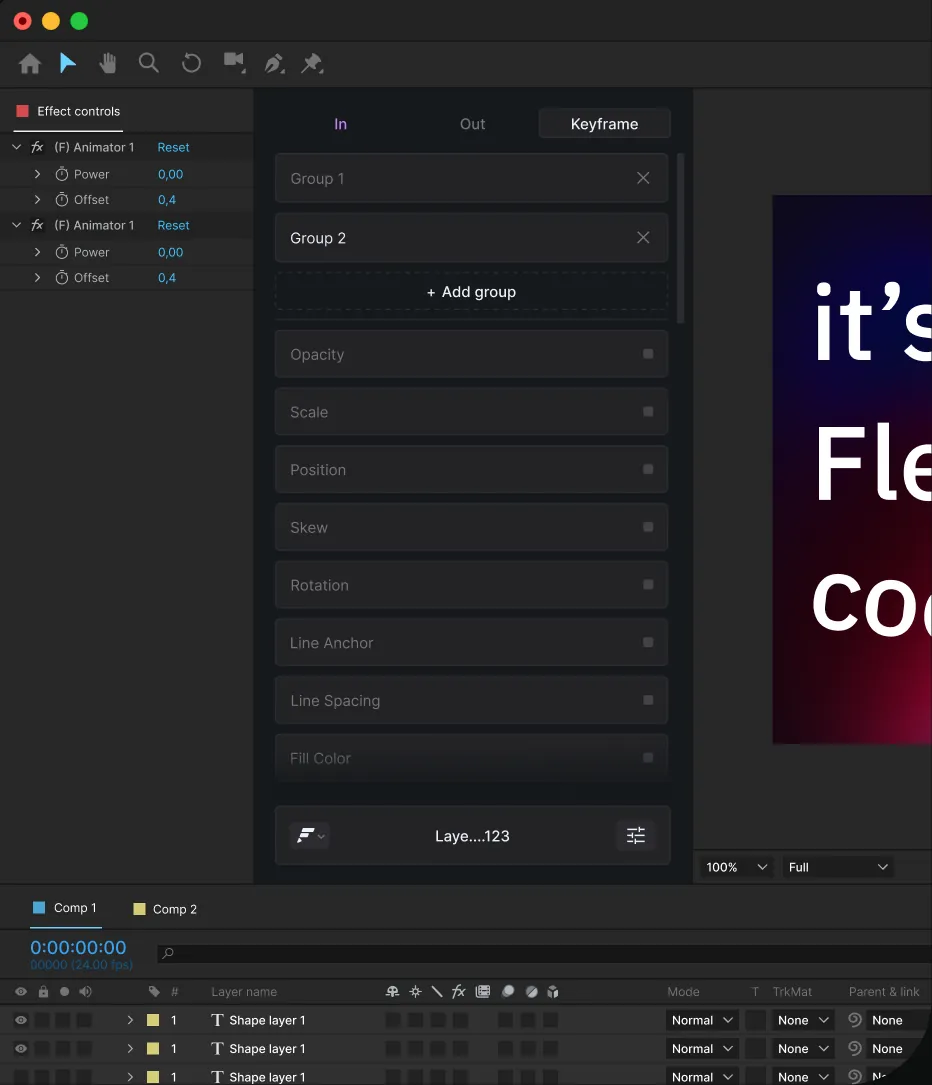
After Effects has no built-in speech-to-text: Adobe documents Speech to Text as a Premiere Pro feature. To get Whisper subtitles into After Effects, you either import an .srt file made outside it with a caption tool, or use an extension that transcribes for you. Flexile, our own After Effects extension, runs Whisper on your computer through whisper.cpp. You pick one of five models, click Transcribe, review the subtitles and create one text layer per subtitle. Your audio is never uploaded, and you need no API key or speech-service account.
For the feature overview rather than the technical detail, see auto subtitles in After Effects.
In this guide
- What is Whisper?
- What is whisper.cpp?
- Which Whisper model should you use?
- How fast is local Whisper?
- What your computer needs
- Where the models are stored and how to delete them
- Make Whisper subtitles in Flexile, step by step
- Other speech-to-text caption tools
What is Whisper?
Whisper is OpenAI’s speech recognition model, published on GitHub under the MIT licence. It comes in six sizes, four of them with English-only versions: tiny (39 million parameters), base (74 million), small (244 million), medium (769 million), large (1,550 million) and turbo (809 million). OpenAI describes turbo as an optimized version of large-v3 that is not trained for translation.
According to OpenAI’s speech-to-text guide, Whisper supports 98 languages, and accuracy varies by language. Flexile’s language picker lists 32 of them plus Auto-detect.
What is whisper.cpp?
whisper.cpp is an open-source C/C++ implementation of Whisper from the ggml-org project, also under the MIT licence. It has no dependencies and runs on macOS (Intel and Apple silicon), Windows, Linux and other platforms. On Apple silicon it runs the model on the GPU through Metal. It also supports integer quantization, and quantized models need less memory and disk space.
Flexile 0.17.0 uses whisper.cpp 1.9.2 and runs it as a separate process on your computer. There is no Python to set up and no separate installer: the speech engine is a 3.6 MB download on macOS (3.5 MB on Windows) that comes with your first model. On a Mac, the engine uses Metal on Apple silicon and Apple’s Accelerate library on Intel Macs with macOS 13.3 or newer.
Which Whisper model should you use?
Flexile offers five models. The panel shows each one’s size and a short note:
- Tiny, 32 MB: fastest, rough.
- Base, 60 MB: fast.
- Small, 190 MB: good for speech. This is the model Flexile offers first.
- Medium, 539 MB: better with accents.
- Large v3 Turbo, 574 MB: best for songs.
Start with Small for voice-overs, interviews and tutorials. Switch to Medium when a speaker has a strong accent. Use Large v3 Turbo for sung lyrics: on our demo song it matched 51 of 53 lyric words to what it heard in “I have the lyrics or script” mode. Tiny and Base are the quick options when speed matters most. After your first download, Flexile defaults to the largest model you have installed.
Flexile also filters mistakes Whisper is known to make on music. Words placed after the end of the audio are dropped, and a short phrase repeated more than four times is cut to four.
Why the sizes differ from the whisper.cpp list
Flexile’s files are quantized whisper.cpp models: q5_1 for Tiny, Base and Small, and q5_0 for Medium and Large v3 Turbo. The whisper.cpp model list gives 75 MiB for the full tiny model and 1.5 GiB for large-v3-turbo, but 547 MiB for large-v3-turbo-q5_0. That is the 574 MB file Flexile downloads, since the panel counts in decimal megabytes.
How fast is local Whisper?
Speed depends on the model and the computer. We measured on one computer, with an i9-9880H processor using 8 threads. The numbers are processing time as a share of the audio’s length, so anything below 1× finishes faster than the audio plays:
- Small on speech: about 0.3× on Windows and 0.23× on macOS.
- Large v3 Turbo on songs: about 1.1× on Windows and 0.56× on macOS.
One transcription runs at a time, and a clip can be up to 20 minutes long.
What your computer needs
- After Effects 2025 or newer, the version Flexile supports, and Flexile 0.17.0 or newer, the release that added the Audio page.
- A Mac with Apple silicon, or an Intel Mac with AVX2 (2013 or newer).
- Or a Windows PC with a 64-bit Intel or AMD processor that supports SSE4.2, with the Microsoft Visual C++ runtime installed. Windows on ARM is not supported.
- Disk space for the models you download: 32 MB to 574 MB each, plus 3.5 to 3.6 MB for the engine.
- A Flexile account, signed in inside the panel. It is free during beta.
Beat keyframes, the other tab of the Audio page, work on any computer where Flexile runs, including those that cannot run subtitles.
Where the models are stored and how to delete them
Flexile keeps the speech engine and models in its own folder:
- macOS:
~/Library/Application Support/Flexile/whisper - Windows:
%APPDATA%\Flexile\whisper
The engine sits in engine/ and each model in models/. To free the space, open Settings > Speech models in the panel. It lists the installed models with their size, and you can delete any of them there.
Nothing downloads until you click Download, and Flexile’s automatic updates never install the engine or models. When a newer version is available, it installs only when you click Update. Downloads come from Flexile’s servers, resume after an interruption and are checked against the published size and SHA-256 checksum.
Make Whisper subtitles in Flexile, step by step
- Open Window > Extensions > Flexile for AE and sign in.
- Select the layer with the sound (a voice-over, a song or a video), or use the whole comp mix, and open Audio > Subtitles.
- Pick the language, or keep Auto-detect. Auto-detect listens to the first 30 seconds, so choose the language yourself for songs.
- Pick a model. The first time, click Download. The first download also brings the speech engine.
- Click Transcribe. If you already have the script or lyrics, first switch on I have the lyrics or script and paste the text or load a text file. The button then reads Time my text. Your words stay exactly as written, and each line becomes one subtitle.
- Review the list. Edit or remove any subtitle, and choose how captions split: Your lines (when you supplied your text), Length, Phrases (2 to 4 words) or Words. The defaults are 42 characters per line and 2 lines.
- Pick a style. Select one of your own text layers and every subtitle copies its font, size, colour, position, effects and Flexile IN/OUT animation. Or use a preset: Clean, Outline, Bold yellow or Lower third.
- Click Create subtitle layers. Flexile creates one text layer per subtitle in one undo step. To get a sidecar file as well, export the captions as .srt or .vtt.
In lyrics mode, Flexile matches your words to the words Whisper hears, and any word it missed gets a time between its neighbours. When you create subtitles again in the same comp, Replace earlier subtitles (on by default) deletes the subtitle layers Flexile made there before.
For lyric videos, switch on Highlight the word being said and the active word changes colour, yellow by default. The full walkthrough is in word-timed karaoke.
Let your AI app do it
If you connect an AI app to Flexile, it can caption over MCP: it asks Flexile to transcribe the audio on your computer, reads the captions and creates the subtitle layers for you. It cannot download models, so click Download once in the panel first.
Add subtitles to the voice-over in the Outline style.
Other speech-to-text caption tools
Flexile is our own product. Other tools that turn speech into captions, with facts and prices from each vendor’s page as checked on 25 September 2026:
- Voice2Captions (Future Tools) transcribes through the service you choose, Deepgram, Groq or OpenAI Whisper, with your own API key. It costs $19.98 for a single-user licence, and a free trial is listed.
- AutoCaption (creadreamproduction) uses Deepgram Nova-3 and OpenAI Whisper Large v3, online through the vendor’s servers or offline on your machine, with no API key needed. It costs $8 a month, $80 a year or $150 perpetual, with a 7-day free trial.
- Captioneer (Mograph Mindset) runs locally with NVIDIA Parakeet or a Large V3 model, in After Effects and Premiere Pro. It costs $15 a month or $150 one-time, with a 14-day free trial.
- If you edit in Premiere Pro, its built-in Speech to Text transcribes there. Adobe’s language list names 18 languages.
Flexile is free during beta, and paid plans will be announced in advance. For a wider list that includes AI assistants and MCP servers, see AI tools for After Effects.
What you need
Flexile runs in After Effects 2025 or newer on macOS and Windows and is free during beta. Subtitles need a Mac (an Intel Mac needs AVX2) or a Windows PC with a 64-bit Intel or AMD processor. Once the panel is installed, open Audio > Subtitles and download the Small model to start.
Related posts
How to make karaoke text in After Effects
Paste the lyrics and let Flexile time every word to the song and highlight it as it is sung, or build a word highlight by hand with a Fill Color text animator.
Word-by-word and typewriter text animation in After Effects
Reveal text one word at a time with a Range Selector based on words, turn it into a typewriter with Smoothness at 0%, or let Flexile stagger the words for you.
Best AI plugins for After Effects (2026)
AI plugins for After Effects that add an AI assistant, let Claude and Cursor work in your comps, generate images and video, or make depth maps and captions. Prices and versions from each official page, September 2026.